Press Release
Protocol Gap: Indonesia Highlights Media Vulnerabilities Amid AI Expansion
Tim Sekretariat
Sabtu 31 Oktober 2026

Surabaya, October 28, 2026 — Indonesian news publishers risk losing both website traffic and the economic value of their content as artificial intelligence (AI) companies collect data from news websites to train models and power digital services. Meanwhile, measures to protect journalistic content remain limited across Indonesia’s news industry.
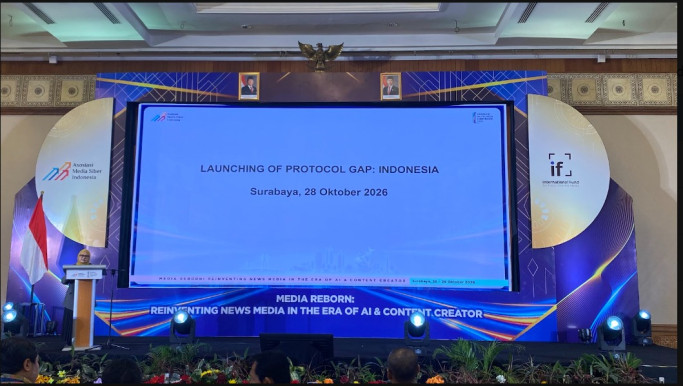
These findings were presented at the launch of The Protocol Gap: Indonesia during the Indonesia Digital Media Conference (IDMC) 2026 in Surabaya on Wednesday, October 28. Organized by the Indonesian Cyber Media Association (AMSI), the conference runs from October 28–29 under the theme “Media Reborn: Reinventing News Media in the Era of AI & Content Creator.”
The report is a collaborative effort by AMSI, Monash University Indonesia, the Journalism Relay Project, PR2Media, and the International Fund for Public Interest Media (IFPIM). It examines how Indonesian news websites manage automated bots that collect online content for various technological purposes, including AI development.
Ika Karlina Idris, a researcher at Monash University Indonesia, said news publishers hold valuable assets in the form of journalistic data, particularly timely, verified reporting and local-language content. However, the economic value generated from this data does not necessarily flow back to the organizations that produce it.
“AMSI has a lot of data gold, but no fences around it,” Ika said during the presentation.
She noted that competition among global AI companies for high-quality data is intensifying. Journalistic content is particularly valuable because it provides timely, constantly updated information, including reporting on local issues that may be difficult to find elsewhere.
Most News Websites Have Robots.txt, but Few Use It to Block AI Crawlers
The Protocol Gap: Indonesia assessed content protection practices across 1,565 Indonesian news websites. The findings show that 74.6% have implemented robots.txt, a file that allows website operators to communicate access rules to automated bots.
However, the presence of a robots.txt file does not necessarily guarantee protection against AI bots scraping website content. In fact, only 10 of news websites use robots.txt directives to block at least one AI crawler or data scraper.
This represents an increase from 5.8% in July 2026, but the overall level of restriction remains limited.
Ika compared Indonesia’s findings with those from other countries in the Protocol Gap research series. In South Africa, 30.4% of news organizations had implemented similar restrictions, while the figure in Brazil was approximately 7 percent.
The findings suggest that protecting journalistic content is not simply a matter of having the right technology. It also depends on publishers’ awareness, technical capacity, and business strategies for managing their digital assets.
Ika also cited research findings indicating traffic declines in the range of 20–70 percent. While the figures should be interpreted in the context and scope of the underlying measurements, they point to the pressures publishers face as audiences increasingly turn to AI-powered services for information.
As AI assistants and AI-powered search engines provide answers directly to users, readers may have less reason to visit the original news websites. Publishers can consequently lose traffic, opportunities to build direct relationships with readers, and revenue associated with their content.
Ika said this reflects a broader imbalance in the global digital ecosystem: technology companies can use journalistic content to develop their products, while publishers risk losing traffic without receiving fair compensation for that use.
Local Publishers Face Greater Challenges
Commercial agreements between technology companies and content owners demonstrate that data has economic value. Ika cited OpenAI’s agreement with News Corp and Google’s payments to Reddit for access to content.
She also referred to the copyright settlement involving Anthropic and authors in the United States. These cases illustrate how the use of content for AI training has become a significant business and legal issue globally.
However, not all publishers have the resources to negotiate with major technology companies. Smaller outlets, particularly local news organizations with only three to ten employees, face greater challenges.
Local publishers produce reporting on communities, regional affairs, and local issues that can be valuable to AI systems. Yet limited staffing and technical infrastructure make it harder for them to audit bot activity, develop content protection strategies, or negotiate compensation for the use of their work.
Larger publishers may have stronger bargaining positions because they possess greater volumes of content and more resources. When negotiations take place individually, smaller outlets risk falling further behind.
Technical Controls Must Be Matched with Business and Legal Strategies
Irene Jay Liu, Director of AI, Emerging Technology & Regulation at the International Fund for Public Interest Media (IFPIM), said technological change requires publishers to understand how their information is being used across digital systems.
In her virtual remarks, Irene emphasized that journalism’s sustainability depends not only on producing quality information but also on maintaining business models that enable journalistic work to continue.
She noted that robots.txt and other technical protocols can help publishers manage how automated systems access information on their websites. However, there is no single approach that works for every organization.
“Every business is different. The decision to allow information to remain open to different crawlers or to restrict access has to be a choice made by the organization itself,” Irene said.
She stressed the importance of making these decisions based on a clear understanding of their potential consequences. Collaboration among publishers, technology companies, and civil society is also essential to safeguarding journalism’s future.
In Indonesia, the issue is closely linked to legal certainty around the use of journalistic content. Ika said AMSI is advocating for revisions to Law No. 28 of 2014 on Copyright to ensure that news articles and other content produced by media organizations receive adequate protection.
Technical restrictions alone cannot resolve questions of content usage rights, the distribution of economic value, or compensation mechanisms. Effective protection requires a combination of technical measures, business strategies, and a supportive legal framework.
A Strategic Choice for Publishers in the AI Era
Through The Protocol Gap: Indonesia, the researchers encourage publishers to assess how well their websites are protected against automated data collection.
Practical first steps include reviewing robots.txt configurations, identifying bots accessing their websites, and establishing clear policies on which content automated systems may or may not access.
These assessments should be accompanied by an understanding of the business implications of each decision. Allowing access can help content remain discoverable through search engines and digital services, but it may also enable content to be used without generating direct visits to the original website. Conversely, overly broad restrictions can affect a publisher’s visibility across certain services.
Publishers therefore need to tailor their access policies to their individual needs, resources, and business strategies.
Ika emphasized that these challenges extend beyond Indonesia. Countries across the Global South face similar difficulties in dealing with global technology companies that possess significantly greater resources and influence.
Cross-border collaboration, including with partners in South Africa and Brazil, is essential to strengthening publishers’ collective position and advocating for fairer governance of journalistic content.
The launch of the report marks another step toward helping Indonesian publishers understand the risks associated with the use of journalistic data in the AI era. The challenge is not merely to ensure that news remains discoverable, but also to protect the economic value of content produced through substantial journalistic investment and safeguard the long-term sustainability of news businesses.
Read the full report, The Protocol Gap: Indonesia, at bit.ly/protocolgap.